Saturday, August 15, 2026 Facebook | Twitter | Linkedin
Magazine

Mining & Trade News

Malawi Online News
...
Mining

MINING FOR FOOD SECURITY: THE STRATEGIC ROLE OF AGROMINERAL RESOURCES IN MALAWI
August 14, 2026 / with Moses Masingati The author is a geological engineer and exploration geologist with experience in mineral resource exploration and development across Malawi. Contact details: +265 991 24 79 03 Email: masingatimoses@gmail.com
...
Mining

MILITARY INVOLVEMENT IN MINING DRAWS MIXED REACTIONS
August 13, 2026 / Maggie TEMBO
...
Mining

Governing Malawi’s Critical Minerals: Policy Pathways for a Just Energy Transition
August 13, 2026 / Emmanuel Chinkaka, Lecturer and Head of Earth Sciences Department., Malawi University of Science and Technology (MUST)
Business
Ecobank Malawi registers K4-billion profit
August 07, 2020 / Wahard Betha

Ecobank Malawi says its profit before tax grew by 5% to K5.4-billion while profit after tax increased by 8% to K4-billion in the financial year ended June 30.

In a summary unaudited financial statement for the year ended June 30, 2020 signed by MD Charles Asiedu and Chairman Leonard Chikadya, the financial house says the results manifest resilience of the Bank in light of the coronavirus (Covid-19) pandemic and political instability owing to the disputed 2019 elections, which had a knock on effect on business.

“The financial performance underscores the resilience of the Bank arising from our leadership position in trade finance, the digitization of our products and services and better efficiency in delivering our customer-centric services,” says Asiedu.

He states that in the year ended June 30, 2020, the Bank’s operating income at MK9.6 billion declined year-on-year by 8% on account of slowdown in business due to the political uncertainty and Covid-19.

Asiedu says benefiting from continued strategic cost, management and reduced business, operating costs were flat year-on-year at Mk4.2 billion resulting in cost to income ratio of 44%.

He also says impairment loss charges reduced year-on-year by 96% to MK54 million arising from improved risk management practices.

The Bank’s total assets increased to K278 billion representing growth of 19% which was driven by an increase of 13% in deposits from customers and funding from other banks which grew by 54% to MK124 billion.

The loan book decreased to K35 billion representing a reduction of 8%, which resulted from lower utilization of facilities by the bank’s major customers.

During the year under review, the Bank was awarded the Banking Brand of the Year 2020 while its MD scooped the Banking CEO of the Year from the Global Banking and Finance of the UK.

“The awards underpin the confidence that customers, stakeholders and the public have in the Bank and its leadership,” says Asiedu.

Meanwhile, the Bank has projected a challenging economic outlook in the second half of the year 2020 due to Covid-19 whose cases are increasing at an alarming rate in the country.

Asiedu says: “Accordingly, earlier projections of Gross Domestic products (GDP) growth, inflation, interest rates and exchange rates may be negatively impacted by Covid-19 in the short to medium term.”

“The ushering in of a new government after the fresh presidential elections could affect policy making and implementation. The Bank has put in place strategic initiatives aimed at mitigating the effects of Covid-19 on the Bank and staff.”

The Bank is accelerating the sale of its world class digital solutions targeting every Malawian in the second half of the year.

 “We are cautiously optimistic about the future and we will continue to make the appropriate investments to bring more value to our customers and other stakeholders,” says Asiedu.

Construction
Preparations for construction of 350MW Mpatamanga power plant advances
August 06, 2020 / Noel Mkwaila

The Malawi Government says it is advancing with the procurement process for the long-awaited construction of Mpatamanga Hydropower plant on Shire River following the prequalification of a consortium comprising SN Power Invest Netherlands B.V and Electrite De France SA (SN Power and EDF SA) as a preferred strategic investment partner for the project.

Acting CEO for Malawi Public Private Partnership Commission (PPPC) Audrey Mwala says the Commission is currently assessing documents submitted by the consortium to determine their capability to invest in the project.

Mwala says the procurement stage will go on up to early 2021 when the investors and the Commission are expected to kickstart the process to identify a contractor to execute the project.

“This contractor identification process will cost us almost half a year since we will be looking at a number of factors in identifying the construction company,” says Mwala.

She says PPPC is committed to ensure that construction of the plant starts as soon as the contractor is identified.

Malawi is backing on the power plant to increase its electricity generation capacity to do away with the electricity blackouts emanating from the load shedding programme that the Electricity Supply Commission implements to ration power supply.

Construction
Malawi Govt. seeks bids for construction of irrigation canals
July 29, 2020 / Christopher JIMU

The Malawi Government is inviting sealed bids from eligible bidders for the construction of irrigation canals in lower Shire Valley area.

The construction of Main Canal 1 and Main Canal 2 is part the Shire Valley Irrigation Scheme under the auspices of the US$563-million Shire Valley Transformation Program, which is financed by the World Bank and the African Development Bank.

 “The works under contract covers the construction of Main Canal 1 (MC1) from Station 6+000 up to 32+788 (Bifurcation point), and part of Main Canal 2 (MC2) from Station 0+000 (Bifurcation point) up to Station 18+024, (Lengwe national park),” says the Ministry of Agriculture in a Press Release.

It says the works will include construction of two inverted siphons on MC1, three inverted siphons on MC2, bridges, box culverts, canal crossing structures, concrete lined canal, and wire fencing around populated areas. The works are located in Chikwawa District.

“Bidding will be conducted through the International Competitive Bidding procedures as specified in the World Bank’s Guidelines: Procurement of Goods, works and non-consulting services,” states the Ministry.

The deadline for submission of bids is September 21, 2020 and interested eligible bidders may obtain further information from the Shire Valley Transformation Program -1.

The project development objective for Shire Valley Development Programme – 1 is to provide access to reliable gravity fed irrigation and drainage services, secure land tenure for smallholder farmers and strengthened management of wetlands and protected areas.

SVTP is a program of three sequential but partially overlapping phases (with different financiers entering at different times and in parallel financing arrangements).

Energy
Bids sought for construction of US$127-M Malawi-Mozambique Power Interconnector
July 23, 2020 / Christopher JIMU

The Electricity Supply Corporation of Malawi (ESCOM) and the Electricidade de Mozambique E.P (EPM) are inviting sealed bids from eligible bidders for the construction of a power interconnector from Matambo Substation in Mozambique to Phalula substation in Balaka, Malawi.

The assignment will be financed by the World Bank administered Norwegian Trust Fund, the World Bank, the European Union, and Germany Technical Cooperation through KFW.

Bidding will be conducted through international competitive procurement using a Request for Bids (RFB) as specified in the World Bank’s Procurement Regulations and is open to all eligible bidders as defined in the Procurement Regulations.

The deadline for submission of bids is September 22, 2020.

The US$127-million project entails the construction of a 218 km power interconnector, thus 142 km in Mozambique side and 76 km in Malawi side.

The project will interconnect Malawi and Mozambique’s transmission systems to enable them to engage in bilateral and regional power trade through the Southern African Power Pool (SAPP).

Mozambique expects electricity exports to Malawi to begin in 2022 and the Tete-Phombeya line will also to be used to supply electricity to towns and villages located along its route in Mozambique.

Malawi’s interest in buying electricity from Mozambique was formalised in 1998 with the signing of a memorandum of understanding in its capital city Lilongwe.

This project will fund Malawi’s first interconnection to the SAPP, which is the first and the most advanced power pool in the continent providing an alternative to domestic electricity generation to improve energy security.

The interconnector will help address Malawi’s sectoral challenges, including chronic electricity supply deficits and ensure security of supply as well as reliability and affordability of electricity through imports from Mozambique and, in the future, other SAPP members.

It also reduces the potential for a power crisis based on droughts affecting the Shire River which produces up to 99% of Malawi’s electricity and addresses the need for back-up in the form of diversified external sources of power.

Trade
Malawi enacts law to bring sanity to international trade
July 22, 2020 / Bester Kayaye

A local economic expert says operationalization of the Control of Goods Act (COGA) by the Ministry of Trade will enhance local industrial productivity and ensure transparency on trade system.

Ministry of Trade has enacted COGA, a law to regulate Malawi’s importation and exportation of goods through imposition of restrictions, banning or allowing of exports or imports under licences.

According to the Press statement from the Ministry,” the law came into operation on July 10, 2020 following Publication of the Act in Government gazette on July 16,2020.”

“The new Act serves as a departure from old Act in that it brings in predictability, certainty and transparency which will facilitate Investment into doff sectors of the economy without interruptions,” reads part of the statement.

Speaking in an interview, Former Executive Director for Economic Association of Malawi(ECAMA), Edward Chilima hails the Ministry for effecting the law saying it is amongst trade interventions that were supposed to be imposed long time ago.

He says: ” This is a welcome development as it is to bring sanity on imports and exports, having noted that many tend to import goods of which basically we are not supposed to be importing, since these can be locally produced and distributed.”

“This will ensure that we import and export goods in line with national development and economic goals, as some goods are also not supposed to be exported to other countries for strategic reasons.”

Chilima, therefore, urges the Ministry to intensify monitoring measures to press on stakeholders involved in trade including Banks, Malawi Revenue Authority and Immigration department to adhere to the Act.

Meanwhile Malawi’s exports to the East African market are expected to be enhanced during and beyond the Covid-19 pandemic period, following Britain’s offer to support the Trade Mark East Africa (TMEA) project with $50 million.

TMEA was established as a non-profit making institution for aid for trade delivery in East Africa.

Among others, the project is to foster reduction of costs and time of trade and ensuring that Malawian products are competitive on international markets.

Construction
Malawi Govt. to construct military hospital in Lilongwe
July 19, 2020 / Tawonga Nyirenda Mayuni

The Malawi government is planning to start construction of a modern military hospital at Kamuzu Barracks in Lilongwe.

Spokesperson for the Ministry of Health Joshua Malango confirmed to Mining & Trade Review that the project is currently at the design stage.

“Once the design is out, the Ministry will advertise for the procurement of works so that a contractor is identified and construction begins,” he said.

Finance and Economic Planning Minister Joseph Mwanamveka said in his presentation of the 2020/2021 national budget statement that the government has engaged a consultant to develop the design of the hospital which will be ready end July 2020.

“The government is also in discussions with would be financiers of the project,” he said.

The Malawi government has allocated K195 billion for the health sector in the 2020/20121 financial year, which represents 9.7% of the total budget.

In the new financial year, the Malawi government plans to complete construction of the Domasi Community Hospital, Phalombe District Hospital, the National Cancer Treatment Centre in Lilongwe, and three health centers and Umoyo houses in 29 sites across the country.

The government has also planned to kick start construction of Mponela Community Hospital in the 2020/2021 financial year.

Construction
Covid-19 hits Malawi’s construction industry
July 10, 2020 / Wahard Betha

The National Construction Industry Council (NCIC) says the outbreak of the novel coronavirus (Covid-19) has affected operations and the supply chain of the construction industry.

NCIC CEO Linda Phiri told Mining & Trade Review in an interview that the Covid-19 pandemic has hit the construction industry due to the sector’s over reliance on imported products and government’s restriction measures to ease the spread of the virus, which have lowered work performance.

Phiri said: “The Construction Industry has been affected mainly in three perspectives, first is the disturbance of the supply chain including source of materials both imported and local materials as borders, shops and factories either have remained closed or scaled down on operations.”

“Secondly, the operations on sites had to be scaled down or modified which has affected the rate of progress of the works; and finally incorporation of measures to control and manage the spread of the pandemic has affected the financial performance of the construction industry.”

Phiri said the pandemic has also affected the council’s financial performance following the suspension of all trainings that the council offer and charges its levy.

The NCIC’s financial performance is directly related to the performance of the construction industry as levy is charged on completed and certified works.

Phiri said since the trainings have been suspended and most projects slowed down, the rate of levy collection has slowed down, and this as well has resulted in non-collection of fees.

“Following the disturbances in the stated financial sources of the Council, if the situation continues to the end of the year the Council could lose over 30% of its revenue from levies and over 70% of its revenue from training fees,” she said.

Meanwhile, in an attempt to fight against the pandemic, the Council has collaboratively implemented guidelines in all construction sites to ensure that all players are in line with certified preventive measures.

She said the guidelines include; ensuring proper sanitation facilities are in place and procedures properly followed with regard to personal hygiene, sanitizing and restrictive use of tools and equipment; social distancing; and general management of site.

Phiri urged stakeholders in all construction sites to follow the guidelines warning that the Council will be the daily watchdog monitoring compliance and that all non-complying projects will be suspended as a penalty.

NCIC works in liaison with various stakeholders identifying areas that need standards or adoption of standards and coordinating the development of various standards for the construction industry, and promoting the use and compliance with standards.

The Council also plays the role of ensuring that all contractors, consultants, material manufacturers and suppliers and all players in the construction industry are operating within roles set forth in the NCI Act of 1996 and codes of ethics of 2009.

Certification from the council gives a path way for construction companies to carry out construction related activities in Malawi while committing to professional and ethical conduct.

The Council also ensures that the players give a paramount consideration to issues of safety, health and welfare of the public; perform services only in areas of their competence; refrain from any corrupt practices and deception acts; and conduct themselves honorably and lawfully.

Construction
Preparations for construction of Lilongwe Dual Carriage Way advances
July 09, 2020 / Tawonga Nyirenda Mayuni

The Malawi government says it has reached an advanced stage in its plans to upgrade the M1 section from Chidzanja Road Junction to Mchinji Roundabout in Lilongwe to a dual carriage way.

State President Arthur Peter Mutharika said in his State of the Nation Address presented in parliament on June 5, 2020, that the dual carriage way and the Area 18 Interchange currently under construction will help reduce congestion in the Capital City.

Mutharika said: “In order to ease traffic congestion which has of late affected our major cities, Government is implementing some road projects to improve the flow of traffic in the cities and urban centres.”

“Some of these interventions include: Construction of Traffic Interchange at Area 18 on the Parliament Roundabout – Bingu National Stadium Road in Lilongwe which will be completed in the next financial year; and upgrading of the M1 Road in the city of Lilongwe involving construction of a dual carriageway from Chidzanja Road Junction to Mchinji Roundabout. Construction works on this project will commence soon.”
Mutharika also said the Malawi government is advancing with preparations for the rehabilitation of the M1 Road from Kamuzu International Airport to Mzimba Turn Off Junction and Kacheche to Chiweta which will cover a total distance of 347 km.

He said the road fromNsipe to Liwonde, which covers a total distance of 55 km will be upgraded during this coming financial year.

“Weighbridge stations are also to be constructed in Dedza, Bwengu in Rumphi and Madziabango in Chikwawa,” he said.

Rural roads have also been considered in this coming financial year, as the government has launched 72 contracts for construction of bridges with funding from the Roads Fund Administration as a complementary package to rural road improvement projects.

As one way of securing additional revenue for road maintenance, the Malawi government is planning of implementing a Toll gate system on selected sections of the M1 road.

Meanwhile, the Malawi government is also implementing some projects aimed at improving the rail, water and air transport.

Mutharika announced that on air transport, Government has procured navigation and communication equipment, and five fire-fighting engines for Kamuzu and Chileka International Airports in order to ensure safety and security of the airports and airspace.

 On rail transport, he said Government, through the National Transport Master Plan, is working on the construction of a combined rail/road bridge for the Ruo Breakaway at Osiyana near Makhanga in Nsanje on the Limbe– Marka Railway Line and Thyolo–Makhanga Road.

He also said government is rehabilitating and upgrading the 399 km Nkaya – Mchinji Railway Line; constructing the Limbe – Sandama section on the Limbe – Marka Railway Line; and a new railway bridge across the Shire River at Shire North in Balaka.

On water transport, he said Government is implementing the Likoma Jetty project, which commenced in 2019/2020 Financial Year.

“Considerable progress has been achieved in the construction of the jetty whose completion would be very beneficial especially to Malawians living on the islands of Likoma and Chizumulu,” said Mutharika.

Business
Nyasa Cooperative calls for more investment in ASMs
June 30, 2020 / Jacqueline MONJEZA

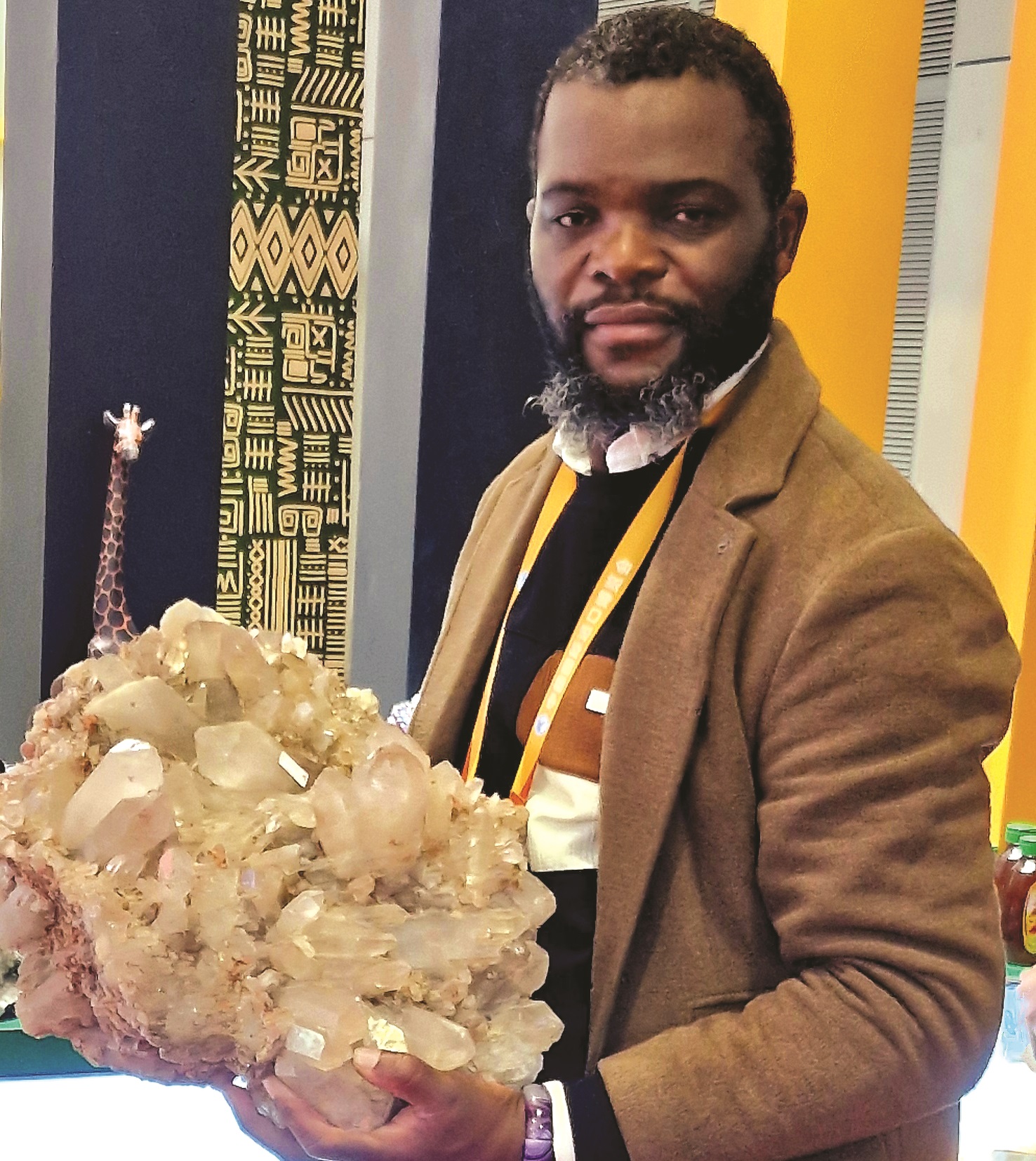
A grouping of Artisanal and Small-scale Miners (ASMs) the Nyasa Mining Cooperative Society says there is a need for Malawi to heavily invest in the ASMs in order for the country’s gemstone products to compete on the world market.

In an interview with Mining & Trade Review, the Cooperative’s chairperson Percy Maleta who was part of a team of local ASMs who showcased products at the International Expo in Beijing, China says as Malawian ASMs, they have learnt that through adequate government and private sector investment in the subsector, other countries have modernized ASMs operations.

“Our friends this side of the world have modernized their mining industry including their ASMs while we are stuck with pick and shovel. Malawi needs heavy investment in the ASMs in order to beat international marketing,” he says.

He explains that through the expo, local ASMs have learnt how business should be done to develop the ASMs subsector in Malawi, which is very young.

“Rubbing shoulders with experienced professionals in the sector was a big boost,” he says.

Maleta proposes that when opportunities arise for local ASMs to showcase at such high profile events, government should help them to secure pavilions by subsidizing costs just as governments of neighbouring countries do in order to enable their ASMs market their products at trade fairs and gemstones exhibitions.

He says: “Zambia is always represented by its ASMs at all major gemstone shows.”

“Zambian ASMs have over four pavilions at the biggest gemstone show in the world in Tucson, Arizona heavily supported by their government.”

“We hope Malawi government will be doing the same.”

Maleta says it is very unfortunate that Malawi has not been aggressive in promoting the ASM subsector as compared to its peers though the country is on the ladder as the next destination for gemstone suppliers owing to more discoveries of minerals that continue to be made.

He, therefore, says it is imperative for Malawi to use this discovery of various minerals to its advantage.

Maleta says: “For Malawi to improve as a country to ensure that our gemstones are competitive on the market and the ASMs subsector adequately contributes to the economy, there is a need for change across the board.”

“Government should seriously consider making ASMs licensing flexible so that we are able to get licenses in all mining hot spots”.

“This can also be done at district level unlike the set up now where a prospective miner has to travel all the way from Marka in Nsanje to Blantyre or Nthalire in Chitipa to Mzuzu just to pay a MK2000.00 for a prospecting license for the district.”

He says such centralization in issuing small-scale mining licenses is encouraging the citizenry to do illegal mining.

Maleta also urges government to invest in ASMs training in mining, value addition and marketing and clearly spell out ASMs subsector support in the national budget just as the case is with small scale agriculture where there are extension workers, lots of subsidies and support.

The Beljing Expo ran from September 15 to 30, and the cooperative was also expected to exhibit at another show in USA from September 5 to 12 under the sponsorship of Export Development Fund (EDF). However, the USA show has been rescheduled to February 1 to 8, 2020.

“We are very thankful to EDF and this is what we are looking forward to as ASMs. We ask other organization to emulate as it is through participating at these shows that we gain the exposure and strike deals,” he says.

In the USA, the cooperative will showcase Malawi gemstones in Tucson, Arizona and at Malawi Embassy in Washington DC.

Maleta says: “It is my wish that the Ministers, Principal Secretaries, and Directors of the following Ministries; Natural Resources, Energy and Mining: Industry, Trade and Tourism; Finance and Economic Planning; and Foreign Affairs and International Cooperation at least attend one gemstone show to really appreciate and understand what other countries that are excelling in the ASM subsector are doing.”

“Let them start with the biggest gemstone and mineral show in the world in Tucson Arizona next year in January or February. These decision makers need exposure just like the miners and we trust that this request reaches them in good faith.”

At the Beljing Expo, Maleta says the Cooperative met five prospective buyers of Malawi gemstones and other minerals and prospects are high that it will sign contracts with the buyers.

He, therefore, describes Nyasa’s attendance of the Expo as a success but says since marketing of Malawi gemstones and minerals is an ongoing exercise, the Cooperative will be attending all major international exhibitions.